Labels

ADLs all four position alphabet letters alphabet writing arts & crafts Attention auditory learner auditory processing beads bilateral motor coordination skills blocks brain bunny story categorization cognitive skills color color dots coloring colors crossing a midline cutting CVC words deep breathing directionality disclaimer dynamic communication Expectations eye-hand coordination Figure 8 fine motor activity fine motor skills first grade folding paper following directions fun Fun game gross motor activity handwriting Handwriting Without Tears hemispheres communicate Home Exercises Program hopping infinity sign jumping kindergarten kinetic input laterality Lazy 8 letter recognition letter reversals letter size letter writing letters Life Skills listening skills math midline milestone milestones money motor coordination skills muscle strengthening object manipulations obstacle course origami parent engagement parent involvement parenting pencil grasp pencil grip phonics play play dough positioning pre-k pre-writing pre-writing skills quad position Sand scissors use Self-care activity sensory activity sensory input shapes shoelaces short term memory sight words simple step directions social skills sorting spacing speech spelling spelling words standing balance stuttering tactile cues task attention therapy ball therapy putty Therapy session unstructured play using a ruler visual attention visual cues visual discrimination visual field integration visual learner visual motor coordination visual motor skills visual perceptual skills visual sequential skills visual skills visual spacial skills visual tracking skills worksheets writing alignment writing name
Showing posts with label visual perceptual skills. Show all posts

Friday, June 12, 2015

Teach Your Child How to Use a Ruler

Using a ruler isn't so simple for some kids.  Kids should have adequate visual motor coordination skills as well as visual perceptual skills.  It seems like a big jargon.  Simply saying, kids should see the lines on the ruler, give a good pressure over the ruler with his non-dominant hand, and draw a line against the edge of the ruler with his writing hand.

So when would be the good time to teach using a ruler?  Obviously you will not ask your 2 year-old toddler to draw a square using a ruler.  Maybe you can show your pre-schooler child how to draw a line with a ruler.  At this age, I am pretty sure your pre-schooler child will be so interested in using the ruler by himself.  But in a minute, the ruler becomes something other than a ruler, like a sword.  Then you may have to take it away for safety and tolerate his whining.  I am just telling you a story about my little one here.  I believe it is a good time to introduce a ruler in pre-school age.  Just casually tell the child the name of the tool "ruler", how to use it, when to use it, and what kinds of things you can do with it.

In the beginning of the Kindergarten year, kids learn numbers and learn to compare bigger and smaller numbers.  As they progress, they learn to subtract and add numbers.  You can start to use a ruler while you play with your pre-schooler or young school-aged child.

Game 1 - Instruction:  "Use the ruler.  Can you draw a line, longer than mine?"

Game 1 - Instruction: Connect the dots with a ruler. (Give two dots to connect.)

Demonstrate how to use the ruler for visual cues.  Say out loud how to use the ruler. "Use your left/right hand to press down on it." "Then draw a line just like me."  

If your child shows difficulty with holding the ruler down, then you can have your hand over your child's hand and give a gentle pressure.  You can also put your hand over the ruler first and place your child's hand over on your hand.  Tell your child to press down on your hand.  

Then see what happen.  Maybe the first line that your child draws is crooked.  But the last line would be different than the first line.

Enjoy teaching and learning~!      

Wednesday, March 11, 2015

Origami: Folding paper

Have you ever tried to follow origami diagrams and instructions? Folding paper inside or outside, or bringing a flap up or down... It doesn't sound so easy, right? Origami requires kids to use their visual skills as well as fine motor skills.
I like origami because kids love the activity. Also, kids can take the origami project home at the end of the session. Kids tend to show better and longer attention span while they participate in the activity.

Here I would like to share ideas of making the activity little easier for kids.

1. You can choose an easy or relatively difficult origami project depending on your child's level of skills and his/her age.
Some projects involve many steps of folding paper and theses are relatively harder than the others.

2. You can give your child extra visual cues by demonstrating first. You show your child how to fold it first.
See if your child follow through.
If he/she follows your instructions and demonstration, that's great!! If not, here are more tips!

3. Give more visual cues on the paper. Draw a line for folding. "This yellow line is where you will fold the paper." "Make the corners pointy."

You can use shapes. "Have the shapes kiss! kiss!" "Have the shapes meet together."
(I stamped dots here. You can simply draw different shapes such as a square, circle, star, diamond, etc. It is a good chance to teach younger kids different shapes.)

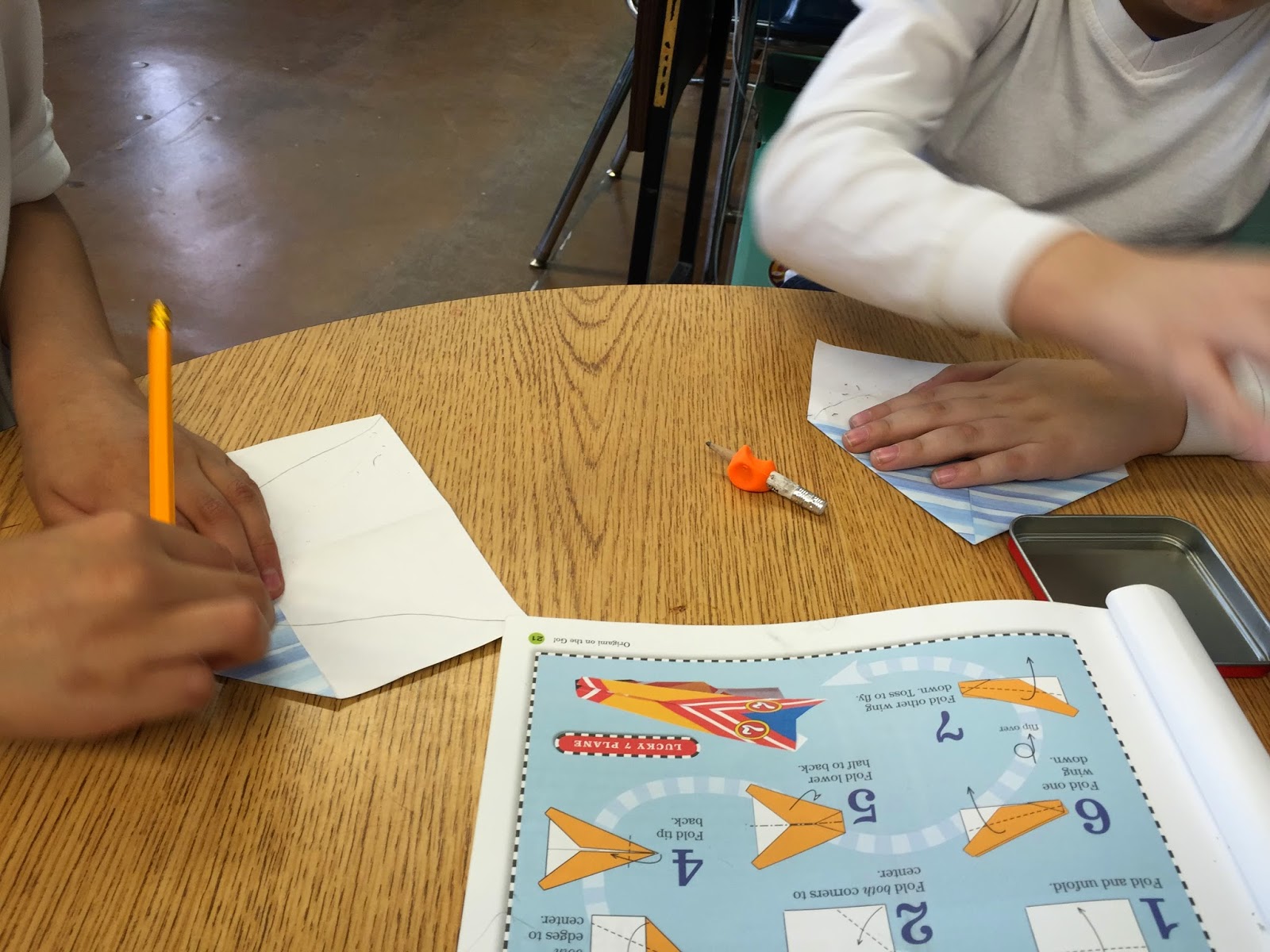
4. These are my second graders. They are trying to draw lines on the paper to understand where they should fold on the paper.
I didn't give them a ruler to draw a straight line.  I wanted them to understand the concept of folding paper from the 'point A' to 'point B'.  You can surely give your child a ruler and see how he/she uses the ruler.  Just remember, using a ruler requires fine motor skills on both hands.  One hand is pressing down on the ruler.  The other hand is drawing a line.  Doing different task on each hand may be not too easy for some kids.

5. Last but not least, I would like to suggest adults giving least amount of assistance to kids in the beginning. Just wait and see how kids are handling difficulty. "Do they try to solve the problem by themselves?" "Do they give up easily?" "Do they ask for help after a few times of trying it?"
You want to learn how your child tries to solve problems and how much assistance she/he needs to do things.

Enjoy learning and teaching~!!

More resources on http://www.origami-instructions.com