Labels

ADLs all four position alphabet letters alphabet writing arts & crafts Attention auditory learner auditory processing beads bilateral motor coordination skills blocks brain bunny story categorization cognitive skills color color dots coloring colors crossing a midline cutting CVC words deep breathing directionality disclaimer dynamic communication Expectations eye-hand coordination Figure 8 fine motor activity fine motor skills first grade folding paper following directions fun Fun game gross motor activity handwriting Handwriting Without Tears hemispheres communicate Home Exercises Program hopping infinity sign jumping kindergarten kinetic input laterality Lazy 8 letter recognition letter reversals letter size letter writing letters Life Skills listening skills math midline milestone milestones money motor coordination skills muscle strengthening object manipulations obstacle course origami parent engagement parent involvement parenting pencil grasp pencil grip phonics play play dough positioning pre-k pre-writing pre-writing skills quad position Sand scissors use Self-care activity sensory activity sensory input shapes shoelaces short term memory sight words simple step directions social skills sorting spacing speech spelling spelling words standing balance stuttering tactile cues task attention therapy ball therapy putty Therapy session unstructured play using a ruler visual attention visual cues visual discrimination visual field integration visual learner visual motor coordination visual motor skills visual perceptual skills visual sequential skills visual skills visual spacial skills visual tracking skills worksheets writing alignment writing name
Showing posts with label visual motor skills. Show all posts

Tuesday, March 31, 2015

Walking on the maze

This is one of the frequently used therapy activities.  You can simply make a track with masking tapes.  When you make the track, try to make some left and right turnings.  You can do many things with this maze.  

(I wouldn't use the duck tapes because it is not easy to take off the duck tapes after use.  It sometimes leave the sticky residue on the floor.)   


In this picture, my first grader is trying to kick the cone right along the line.  In the next picture, the same student tries to dribble the ball along the track.

Obviously the cone does not roll away from him and he shows better control on the cone.  However, it is not the same experience with the rolling ball. He has to do the little kicks and stops the ball continuously.
This activity enhances visual motor skills, visual attention skills, and motor coordination skills.  And kids surely have fun.  Regardless of their difficulties or conditions, kids love challenges and play time.
These are my second graders.  One student is walking on the track with the blindfold and another student tries to give directions to the student. This is a great activity to learn directionality, left and right side. The one who gives directions also has to know the directions in mirror image.  

This activity can enhance their laterality (knowing left and right side in his body), directionality (telling left and right side in space), listening and following directions.    

Are you thinking of the size of your apartment? Yes, my apartment is also very tight and I totally understand this activity is not feasible at home. You can draw the track with the outdoor chalks in the park. You can make a big and long track with your child. There should be no excuses when the weather gets warmer.  Have fun!! 

Saturday, March 14, 2015

Blow it! Spell it!

"Blow it! Spell it!" This activity is similar to the activity that I shared on the previous blog, Enjoy Learning: Spelling Words on 02/27/15.

Prep Materials: Letter paper, straw, and a small piece of crumpled tissue paper

How to prepare the materials:
  • You randomly write down alphabet letters on a piece of paper, preferably bigger than 8x10 notebook size. You can also have your child write down letters.
  • Have your child crumple up the piece of tissue paper. (I colored the tissue paper with a marker just to make it noticeable on the white background paper.)

After the materials are prepared, kids will blow the crumpled tissue paper with the straw from one letter to the next.  You can practice spelling sight words or everyday words with your child.  


What are the benefits of this activity?

As mentioned in the previous blog, this activity helps with kids' visual skills such as visual attention and visual motor skills by tracking and scanning the letters.  

It helps with short term and long term memory performance by reviewing and spelling words.  Let's help them to be a better speller.  Start asking kids to spell easy words to boost their confidence. Don't forget to challenge them as well.   

Blowing through a straw is an oral-motor activity that can help kids with speech development.  

One more thing~!! Importance of breathing...
Deep and slow breathing helps kids to be calm down when they are highly active or feel anxious.  Kids are encouraged to learn deep and slow breathing while performing this activity. 

This activity can be slightly far from being sanitary.  You will see what I mean when you play with your child.  Get ready to make the paper wet! haha~~ :)  

Enjoy Learning, Enjoy Teaching~!


Wednesday, March 11, 2015

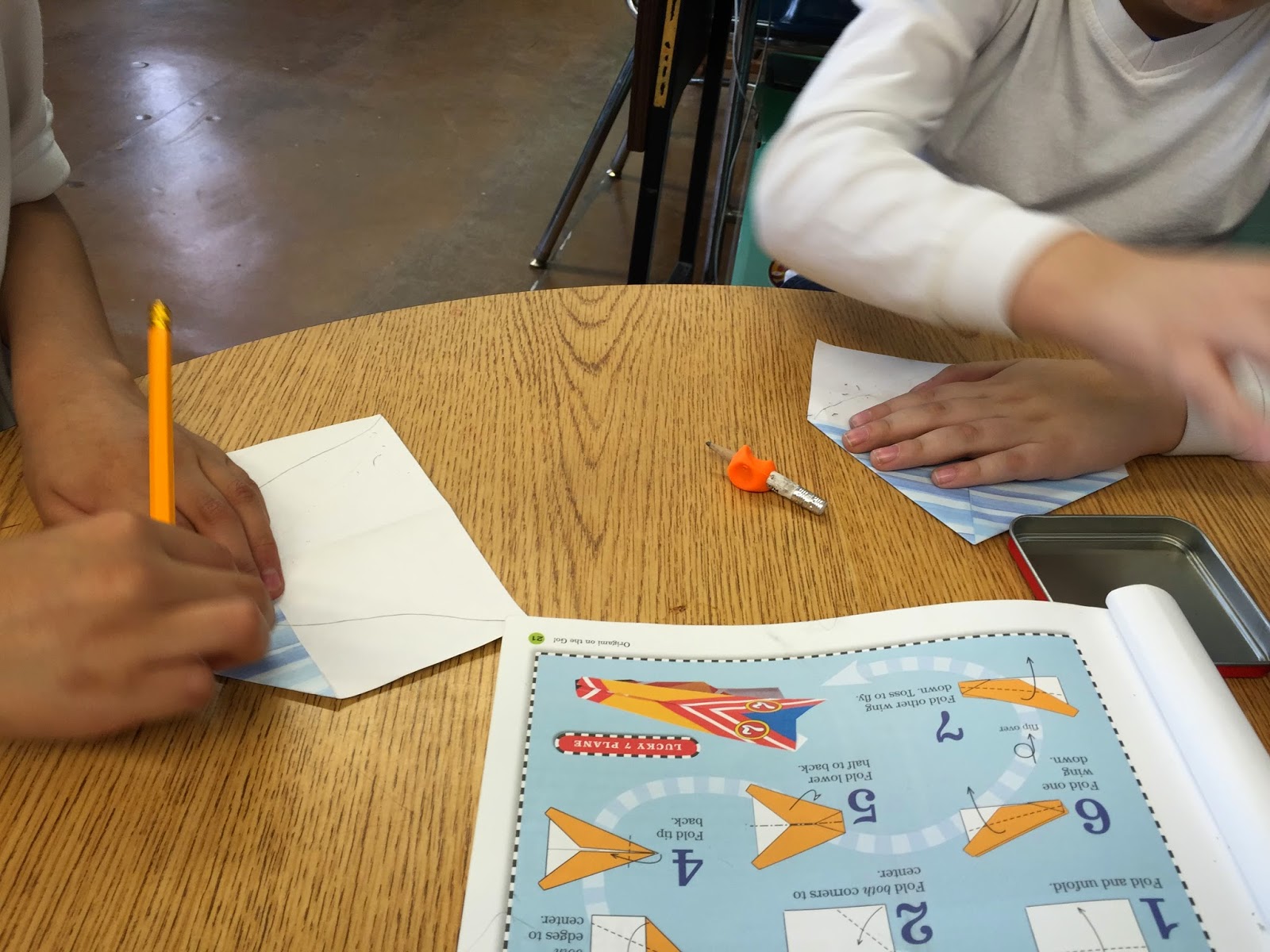
Origami: Folding paper

Have you ever tried to follow origami diagrams and instructions? Folding paper inside or outside, or bringing a flap up or down... It doesn't sound so easy, right? Origami requires kids to use their visual skills as well as fine motor skills.
I like origami because kids love the activity. Also, kids can take the origami project home at the end of the session. Kids tend to show better and longer attention span while they participate in the activity.

Here I would like to share ideas of making the activity little easier for kids.

1. You can choose an easy or relatively difficult origami project depending on your child's level of skills and his/her age.
Some projects involve many steps of folding paper and theses are relatively harder than the others.

2. You can give your child extra visual cues by demonstrating first. You show your child how to fold it first.
See if your child follow through.
If he/she follows your instructions and demonstration, that's great!! If not, here are more tips!

3. Give more visual cues on the paper. Draw a line for folding. "This yellow line is where you will fold the paper." "Make the corners pointy."

You can use shapes. "Have the shapes kiss! kiss!" "Have the shapes meet together."
(I stamped dots here. You can simply draw different shapes such as a square, circle, star, diamond, etc. It is a good chance to teach younger kids different shapes.)

4. These are my second graders. They are trying to draw lines on the paper to understand where they should fold on the paper.
I didn't give them a ruler to draw a straight line.  I wanted them to understand the concept of folding paper from the 'point A' to 'point B'.  You can surely give your child a ruler and see how he/she uses the ruler.  Just remember, using a ruler requires fine motor skills on both hands.  One hand is pressing down on the ruler.  The other hand is drawing a line.  Doing different task on each hand may be not too easy for some kids.

5. Last but not least, I would like to suggest adults giving least amount of assistance to kids in the beginning. Just wait and see how kids are handling difficulty. "Do they try to solve the problem by themselves?" "Do they give up easily?" "Do they ask for help after a few times of trying it?"
You want to learn how your child tries to solve problems and how much assistance she/he needs to do things.

Enjoy learning and teaching~!!

More resources on http://www.origami-instructions.com